Snoring surgery
Dr. L. Galstyan, oral and maxillofacial surgeon in Yerevan, provides comprehensive treatment of snoring and upper airway obstruction, improving breathing function and sleep quality. Through detailed approach, including assessment of jaw position and airway anatomy, and using advanced surgical techniques, including orthognathic and airway-focused procedures when indicated, Dr. Galstyan develops an individualized treatment plan. In collaboration with sleep specialists, each case is managed with precision to achieve stable, long-term results and predictable recovery time.
Diagnosis
To diagnose your condition, your doctor will review your signs and symptoms, and your medical history. Your doctor will also perform a physical examination.
Your doctor may ask your partner some questions about when and how you snore to help assess the severity of the problem. If your child snores, you'll be asked about the severity of your child's snoring.
Imaging
Your doctor may request an imaging test, such as an X-ray, a computerized tomography scan or magnetic resonance imaging. These tests check the structure of your airway for problems, such as a deviated septum.
Sleep study
Depending on the severity of your snoring and other symptoms, your doctor may want to conduct a sleep study. Sleep studies may sometimes be done at home.
However, depending upon your other medical problems and other sleep symptoms, you may need to stay overnight at a sleep center to undergo an in-depth analysis of your breathing during sleep by a study, called a polysomnography.
Treatment
To treat your snoring, your doctor likely will first recommend lifestyle changes, such as:
- Losing weight
-Avoiding alcohol close to bedtime
-Treating nasal congestion
-Avoiding sleep deprivation
-Avoiding sleeping on your back
For snoring accompanied by OSA, your doctor may suggest:
- Oral appliances. Oral appliances are form-fitting dental mouthpieces that help advance the position of your jaw, tongue and soft palate to keep your air passage open.
If you choose to use an oral appliance, you'll work with your dental specialist to optimize the fit and position of the appliance. You'll also work with your sleep specialist to make sure the oral appliance is working as intended. Dental visits may be necessary at least once every six months during the first year, and then at least annually after that, to have the fit checked and to assess your oral health.
Excessive salivation, dry mouth, jaw pain and facial discomfort are possible side effects from wearing these devices.
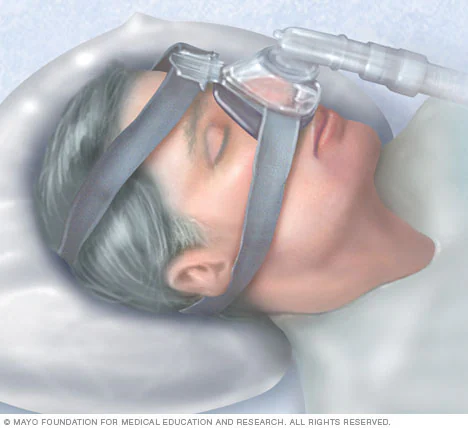
-Continuous positive airway pressure (CPAP). This approach involves wearing a mask over your nose or mouth while you sleep. The mask directs pressurized air from a small bedside pump to your airway to keep it open during sleep.
CPAP (SEE-pap) eliminates snoring and is most often used to treating snoring when associated with OSA.
Although CPAP is the most reliable and effective method of treating OSA, some people find it uncomfortable or have trouble adjusting to the noise or feel of the machine.
-Upper airway surgery. There are a number of procedures that seek to open the upper airway and prevent significant narrowing during sleep through a variety of techniques.
- Uvulopalatopharyngoplasty (UPPP), you're given general anesthetics and your surgeon tightens and trims excess tissues from your throat — a type of face-lift for your throat.
- Maxillomandibular advancement (MMA) involves moving the upper and lower jaws forward, which helps open the airway.
- Radiofrequency tissue ablation employs a low-intensity radiofrequency signal to shrink tissue in the soft palate, tongue or nose.
A newer surgical technique called hypoglossal nerve stimulation employs a stimulus applied to the nerve that controls forward movement of the tongue so the tongue does not block the airway when you take a breath.
The effectiveness of these surgeries varies and the response can be challenging to predict.
Source: https://www.mayoclinic.org